

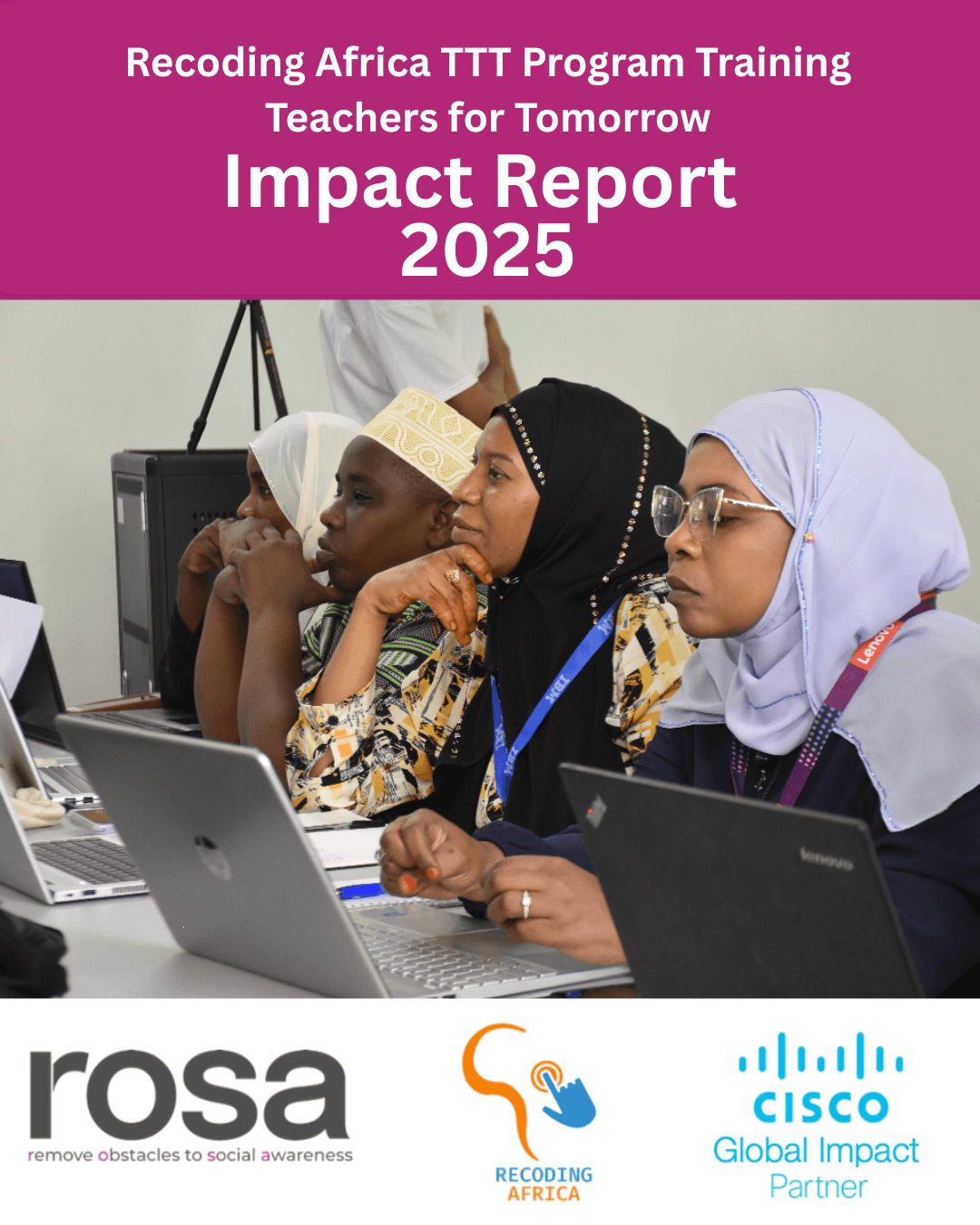
Training Teachers for Tomorrow: How R.O.S.A.’s ReCoding Africa Training Model Is Transforming Digital Education in Zanzibar
In 2025, R.O.S.A. successfully implemented the Training Teachers for Tomorrow (TTT) program in Zanzibar through its ReCoding Africa initiative, marking a significant step toward strengthening digital education in East Africa.
Supported by the Cisco Foundation and delivered in partnership with the Zanzibar’s Ministry of Education and Vocational Training, the program equipped 40 high school teachers with modern ICT skills, digital literacy competencies, and AI-supported teaching methodologies aligned with 21st-century international standards.
Bridging the Digital Skills Gap
Zanzibar stands at a pivotal moment in educational development. With 76% of Tanzania’s population under 25 years old, classrooms must evolve to prepare students for a technology-driven future.
Bridging the digital skills gaps requires more than devices or connectivity. It requires confident, well-trained educators who understand how to meaningfully integrate ICT tools, digital collaboration strategies, and AI-supported learning into everyday teaching practice.
Through the Training Teachers for Tomorrow initiative, R.O.S.A. is investing in educators as powerful catalysts for change, laying a strong foundation for sustainable, long‑term change.
A Model Designed to Multiply Impact
The program followed a Train-the-Trainer framework supported by R.O.S.A.’s Waterfall Impact Model. Ensuring teachers did not simply learn new tools; but they developed the capacity to mentor colleagues and lead implementation within their schools and Teacher Centers.
This approach shifts professional development from short-term training to long-term institutional growth. It builds local ownership and ensures that digital skills continue spreading beyond the initial cohort.
The training blended hands-on workshops, interactive modules, and real classroom applications. Teachers received structured training in:
- IBM SkillsBuild
- Google Workspace (Docs, Classroom, Forms, Sheets)
- Canva and multimedia presentation tools
- Kahoot for interactive learning
- AI-powered research and content creation tools
- Multimedia presentation development
- Digital collaboration platforms
The curriculum combined technical instruction with inclusive, student-centered pedagogy. Teachers were not only trained to use these tools — they were prepared to train other educators, creating a scalable cascade effect across schools and teacher centers.
Measurable Impact: Survey Results from 2025
Pre and post-training surveys demonstrate clear progress across all competency areas.
- General ICT Skills: Increased from 3.19 (pre) to 4.62 (post) demonstrating a 44.69% improvement.
- Digital Literacy: Increased from 3.76 (pre) to 4.55 (post) with a 21.1% improvement.
- Digital Collaboration: Increased from 3.26 (pre) to 4.62 (post) showing a 41.82% improvement
In specific areas such as AI fundamentals and Google classroom integration, improvements reached up to 66%.
Equally important, teachers reported:
- 4.71/5 increase in professional confidence
- 4.55/5 motivation to continue using digital tools
- Strong readiness to train and mentor peers
- These results reflect both technical growth and strengthened professional identity.
Teacher Leadership in Action
Participants consistently highlighted increased confidence as the program’s most transformative outcome. Many described AI and digital tools as empowering rather than intimidating.
Several educators committed to mentoring colleagues, demonstrating tools in staff meetings, and supporting Teacher Centers. This peer-led expansion is central to the Waterfall Impact Model and ensures that the impact extends well beyond the original 40 participants.
Sustainable Implementation
To address infrastructure realities, R.O.S.A. delivered training in facilities with stable connectivity and provided standardized toolkits to ensure equitable access.
Ongoing mentoring sessions established a growing community of practice. In 2026, the launch of a mobile-accessible Teacher Training e-Learning Platform will further expand reach while maintaining instructional quality.
Budget Transparency & Sustainability
The Training Teachers for Tomorrow Program was funded through a $20,000 grant from the Cisco Foundation. Total expenditures reached $20,979, with the remaining balance covered through R.O.S.A. donations.
Transparent reporting reinforces accountability and long-term sustainability.
The Road Ahead
Following the success of the 2025 pilot, R.O.S.A. will certify local Lead Trainers, institutionalize continuous professional development, and expand the model across Zanzibar, Pemba, and mainland Tanzania.
By equipping educators to lead digital transformation themselves, ReCoding Africa establishes a durable, locally driven ecosystem for ICT integration, AI-supported pedagogy, and inclusive 21st-century education.
Why This Matters for Global Education
Education systems worldwide are undergoing digital transformation. However, sustainable change depends on empowering teachers first.
The ReCoding Africa TTT Program demonstrates that:
- Strategic partnerships accelerate impact
- Measurable outcomes strengthen accountability
- Train-the-trainer models create exponential growth
- ICT + AI integration must be paired with pedagogy
- Sustainability requires local leadership development
R.O.S.A.’s 2025 program in Zanzibar offers a replicable blueprint for education reform in emerging economies. For a comprehensive breakdown of outcomes, data, and financial reporting, download the full 2025 Impact Report (PDF).
Discover how R.O.S.A. is advancing digital education and experiential learning across regions — from ReCoding Africa to our programs in Vietnam and Thailand.